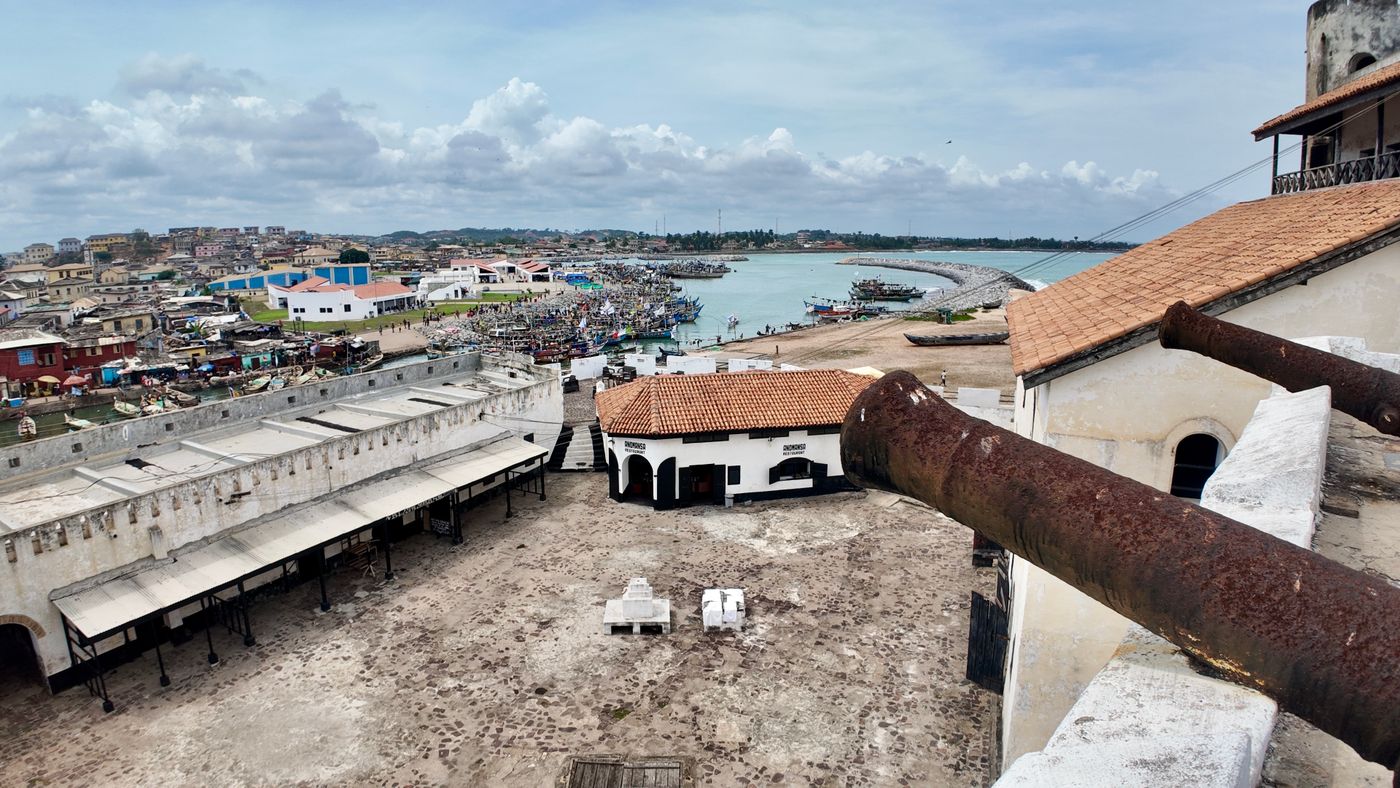
Osu Castle — properly **Christiansborg Castle** — is the historic Danish-built fort at Osu in Accra that served as the seat of Ghana's government for most of the nation's life, and remains one of the most consequential buildings in West African history. **Danish origins (1659–1850).** The Danes began the fort around 1659 on the coast at Osu, naming it Christiansborg after King Christian IV. It changed hands violently — the Portuguese, the Akwamu, and the British all seized it at various points — before the Danes rebuilt and held it as the headquarters of Danish Gold Coast possessions. Under Danish rule it was both a trading post and, grimly, a slave-trading hub; the dungeons beneath the castle held enslaved Africans awaiting shipment across the Atlantic. In 1850 Denmark sold its Gold Coast forts, Christiansborg included, to Britain. **Colonial capital and the road to independence.** The British made Christiansborg the seat of the Gold Coast colonial administration, and it was from here that the colonial governor governed. Its symbolic weight peaked on **6 March 1957**, when Ghana became the first sub-Saharan African nation to win independence — the Union Jack came down and the Black Star went up, with Kwame Nkrumah at the centre of it all. Nkrumah later made the castle his office and residence. **Post-independence seat of power.** From 1957 until 2013, Christiansborg Castle served as the office and residence of Ghana's presidents (with interruptions during military rule). Rawlings governed from it, as did Kufuor, Mills, and Mahama in his first term. In **2013**, President John Dramani Mahama moved the seat of government to the newly built **Flagstaff House** (Jubilee House) in Accra, and Christiansborg was handed to the Ministry of Foreign Affairs and Regional Integration. There have since been proposals to convert it into a **presidential museum** — a fitting use for a building that carries both the pain of the slave trade and the pride of independence. **Architecture and setting.** The castle is a whitewashed, thick-walled coastal fortress with sea-facing bastions, sitting right on the Gulf of Guinea shoreline at Osu. Its dungeons, courtyard, and ramparts are a sobering reminder of the transatlantic slave trade, and it is often mentioned alongside Cape Coast and Elmina castles as part of Ghana's "Door of No Return" heritage corridor. **Visiting.** Christiansborg is not open to the public as freely as Cape Coast or Elmina castles, since it still houses government offices and has security restrictions. If you want to see it, the best views are from the Osu shoreline and the nearby Independence Square area. For a full castle experience with guided tours of the dungeons, Cape Coast Castle and Elmina Castle are the ones to visit. A fitting Akan thought: *"Abosom nni akyi"* — the old shrines have no back; you cannot walk behind history and pretend it isn't there. Christiansborg is exactly that — a building you must face head-on, both its shame and its glory.
Install the App
Tap the “Install App” button in the menu (or the banner at the bottom) to add GhanaMann to your home screen — it opens full-screen like a real app, even offline.